
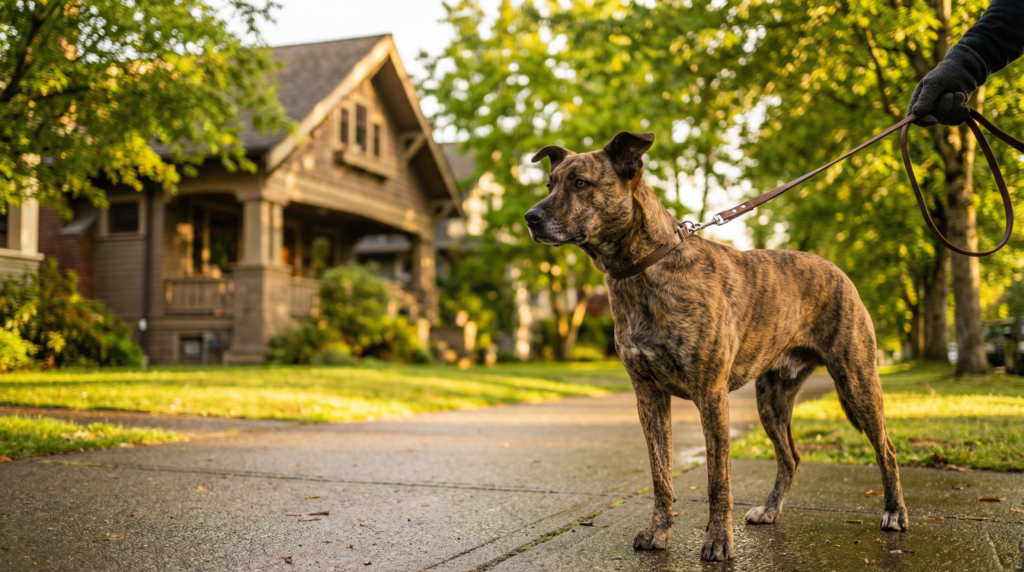
TLDR: Dog reactivity — the barking, lunging, and over-the-top responses to common triggers — is almost always rooted in fear or frustration, not aggression. This deep dive explains the science behind why dogs become reactive, exploring the roles of genetics, early socialization, and the brain’s survival wiring, and provides a compassionate framework for Vancouver dog owners to begin helping their dogs feel safe again.
It’s a scenario many Vancouver dog owners know by heart. You’re enjoying a walk along the seawall or through Marpole’s quiet side streets, your dog trotting happily beside you, when another dog appears in the distance. Instantly, your relaxed companion transforms into a tense, trembling, lunging mess of barks and growls. You feel a familiar mix of embarrassment, frustration, and helplessness as you try to manage the situation, often ending the walk feeling defeated — and wondering what you’re doing wrong.
If this sounds familiar, you are not alone. Leash reactivity is one of the most common behavioural challenges reported by urban dog owners, and Vancouver’s density of people, dogs, cyclists, and skateboarders makes it a particularly common experience here. We’ve worked with many reactive dogs over the years at Marpole Dog Walking, and the single most important thing we’ve learned is this: your dog is not being “bad,” “dominant,” or “aggressive.” Your dog is overwhelmed.
This article is the first in our series dedicated to helping you understand and manage reactivity in your dog. Here, we take a deep dive into the science of what dog reactivity actually is — exploring the complex interplay of genetics, brain chemistry, early experiences, and environment that creates these big emotional responses. Understanding the “why” is the first and most critical step toward helping your dog navigate our busy city with confidence.
What is Dog Reactivity?
In the simplest terms, reactivity is a disproportionate overreaction to a stimulus. While other dogs might see a skateboarder and simply watch them pass, a reactive dog might explode into a frenzy of barking and lunging. This outward display is not the problem itself; it is a symptom of an underlying emotional state — usually fear, anxiety, or intense frustration.
“A reactive dog is one who responds quickly and intensely to external stimuli. The response might involve barking, lunging, whining, freezing, pulling away, or redirecting onto nearby objects or people. These behaviours are not deliberate attempts to be difficult. They are signs that the dog’s threshold has been exceeded and that their emotional state has shifted into survival mode.” [1]
Common triggers for reactive dogs in an urban environment like Vancouver include other dogs (especially when on-leash), strangers — particularly those wearing hats, carrying umbrellas, or moving unpredictably — fast-moving objects like bicycles, skateboards, and strollers, loud or sudden noises, and specific locations associated with a past negative experience.
It’s a common and damaging misconception that reactivity and aggression are the same thing. While a reactive display can look aggressive — the barking, the teeth, the lunging — the underlying motivation is fundamentally different. An aggressive dog typically intends to cause harm. A reactive dog is almost always trying to create distance to make the scary thing go away. The barking and lunging is a communication: “You are too close. Please move away.” However, if a reactive dog’s warnings are consistently ignored and they continue to feel threatened, their behaviour can escalate toward genuine aggression. This is why taking reactivity seriously from the outset is so important.
The Science Behind the Reaction: Inside the Dog’s Brain
When your dog has a reactive outburst, they aren’t consciously choosing to ignore your pleas to “be quiet” or “leave it.” Their brain has been taken over by a powerful, primitive survival mechanism that operates far faster than conscious thought.
The Amygdala: Your Dog’s Smoke Detector
At the centre of this process is a small, almond-shaped structure called the amygdala. Think of it as your dog’s smoke detector — it is constantly scanning the environment for potential threats. When it perceives something dangerous, such as another dog approaching head-on (a posture that is inherently confrontational in canine social language), it triggers an immediate, reflexive survival response before the rational, thinking part of the brain even has a chance to process what’s happening.
This response activates the sympathetic nervous system, flooding the body with stress hormones — primarily adrenaline and cortisol. Heart rate skyrockets. Breathing becomes shallow and rapid. Muscles tense up, preparing the body for action. Attention narrows to a laser focus on the perceived threat. [2] In this state, the prefrontal cortex — the part of the brain responsible for rational thought, impulse control, and accessing learned behaviours — is effectively sidelined.
This is why your highly trained dog suddenly seems to have forgotten every cue you’ve ever taught them in the heat of a reactive moment. They are not giving you a hard time; they are having a hard time. They are physically incapable of accessing learned behaviours because the survival-focused part of their brain is in complete control.
Stress Stacking: Why Some Days Are Worse Than Others
One of the most important concepts for reactive dog owners to understand is stress stacking, also called trigger stacking. Cortisol — the primary stress hormone — does not clear from a dog’s system immediately after a stressful event. Depending on the severity of the stressor, elevated cortisol can persist in the bloodstream for 24 to 72 hours. [2]
This means that if your dog had a reactive episode on Monday morning, they may still have elevated baseline cortisol on Tuesday afternoon. If they then encounter another trigger on Tuesday, they are starting from a higher state of arousal and will hit their threshold much more quickly. This explains why your dog can seem perfectly fine one day and then react to something completely innocuous the next — they are not being unpredictable, their nervous system is simply still recovering.
Practical implications for Vancouver dog owners: after a bad reactive episode, consider giving your dog a quieter day or two. Shorter walks in calmer areas, more indoor enrichment, and less exposure to known triggers will allow their cortisol levels to return to baseline before you attempt another challenging outing.
Understanding Thresholds
Every dog has a threshold — the point at which they move from coping to not coping. Below threshold, your dog can see their trigger, feel some stress, but still function: they can take treats, respond to cues, and make reasonable choices. Above threshold, the amygdala is in control and rational behaviour is impossible.
Thresholds are not fixed. They shift constantly, influenced by factors including the dog’s overall stress load (see stress stacking above), the proximity and intensity of the trigger, the dog’s physical health, sleep quality, hormonal cycles, and even the weather. A dog who can calmly watch another dog from 20 metres on a good day might react at 50 metres on a day when they are tired, in pain, or already stressed.
Recognizing the subtle early signs of rising arousal — a stiffening of the body, a hard stare, a change in breathing, ears pinned forward, a sudden inability to take treats — allows you to intervene before your dog crosses their threshold. This is the foundational skill of managing a reactive dog, and it is one that develops with practice and close observation.
Why Some Dogs Become Reactive: The Contributing Factors
Reactivity does not have a single cause. It is almost always the result of a combination of factors.
Genetics play a meaningful role. Research has shown that fear and anxiety-related behaviours can be heritable, with certain genetic variants linked to increased fear responses. [3] Breeds that were historically selected for vigilance, guarding, or herding — German Shepherds, Border Collies, Australian Shepherds, and many terrier breeds — may be genetically predisposed to be more alert and sensitive to environmental stimuli. This does not mean these dogs are destined to be reactive, but they may have a naturally lower threshold for stress.
Lack of early socialization is one of the most significant contributors. The critical socialization window for puppies is between approximately 3 and 16 weeks of age. During this period, a puppy’s brain is uniquely receptive to new experiences, and positive, controlled exposure to a wide variety of sights, sounds, people, and other dogs helps them learn that the world is a safe and predictable place. Puppies who miss out on this window — whether due to illness, isolation, or simply a lack of opportunity — are significantly more likely to develop fear-based reactivity as adults. [4]
Negative experiences can also create or deepen reactivity at any age. A single traumatic event, such as being attacked by another dog, can create a lasting and powerful negative association. Even repeated minor negative experiences — being startled by a cyclist, being approached by an overwhelming stranger — can sensitize a dog to certain triggers over time.
Pain is a major and frequently overlooked contributor. Chronic, undiagnosed pain from conditions like arthritis, dental disease, or old injuries can lower a dog’s tolerance and increase their vigilance and irritability. If your dog’s reactivity has appeared suddenly or worsened noticeably, a thorough veterinary examination to rule out a physical cause should always be the first step.
Leash Reactivity: A Particularly Common Urban Challenge
One of the most prevalent forms of reactivity in cities like Vancouver is leash reactivity — when a dog who is perfectly relaxed and friendly off-leash becomes a lunging, barking nightmare on a leash. This apparent contradiction makes sense when you understand the mechanics.
When a dog is off-leash, they have two natural options when they feel uncomfortable: approach to investigate or move away to create distance. The leash removes the second option entirely. When a dog feels threatened and cannot flee, they are left with only one choice: make the threat go away by appearing as large, loud, and scary as possible. This is the reactive display.
Additionally, the leash transmits tension directly from the handler to the dog. If you tighten up on the leash when you see another dog approaching — which is a completely natural human response — your dog feels that tension through the leash and interprets it as a signal that something dangerous is indeed approaching. This can actually trigger or amplify a reactive response in a dog who might otherwise have remained calm.
Vancouver-Specific Resources: Certified Force-Free Trainers
If your dog is struggling with reactivity, working with a certified, force-free professional is the most effective path forward. The following Vancouver-area trainers and facilities specialize in reactivity and use humane, science-based methods.
| Trainer / Facility | Specialty | Certification | Format |
|---|---|---|---|
| Raintown Dog Training | Reactivity, puppy training | CPDT-KA | Private & group |
| When Hounds Fly | Reactive Dog Class (group), behaviour consulting | CPDT-KA, VSA | Group classes & private |
| Zen Dog Training | Reactive dog programs (“Growl” program) | Certified behaviourist | Private |
| Hustle Up Dog Training | Reactivity, separation anxiety | Certified | Private & online |
| Pawsitive Cultr | Urban anxiety, sensitive dogs | Behaviour consultant | Private |
When choosing a trainer, look for credentials such as CPDT-KA (Certified Professional Dog Trainer — Knowledge Assessed), KPA CTP (Karen Pryor Academy Certified Training Partner), or VSA-CDT (Victoria Stilwell Academy). Most importantly, ensure they use force-free, positive reinforcement methods only. Punishment-based approaches — including prong collars, shock collars, or alpha rolls — are not only ineffective for reactivity, they actively make fear-based behaviour worse by adding more negative associations to an already stressed dog.
What Comes Next
Understanding that your dog’s reactivity is a neurobiological event — not a character flaw or a training failure — is genuinely transformative. It allows you to respond with patience and strategy rather than frustration and punishment, and it opens the door to real progress.
The next article in this series, “Management Strategies for Reactive Dogs in Vancouver,” will cover the practical, day-to-day steps you can take immediately to prevent reactive episodes and set your dog up for success in our busy city. Following that, we’ll explore the evidence-based training techniques of counter-conditioning and desensitization in detail.
Living with a reactive dog is a journey, but it is one that thousands of Vancouver dog owners are navigating every day. With knowledge, patience, and the right support, you can help your dog feel safer, calmer, and more confident in the world around them.
References
[1] The Dogenius Institute. (2025). Why Dogs Are Reactive: A Science-Led Explanation. Retrieved from https://www.thedogenius.com/blog/science-of-reactivity-in-dogs
[2] Cornell University College of Veterinary Medicine. (n.d.). Managing reactive behavior. Riney Canine Health Center. Retrieved from https://www.vet.cornell.edu/departments-centers-and-institutes/riney-canine-health-center/canine-health-information/managing-reactive-behavior
[3] Zapata, I., Serpell, J. A., & Alvarez, C. E. (2016). Genetic mapping of canine fear and aggression. BMC Genomics, 17, 572. Retrieved from https://pmc.ncbi.nlm.nih.gov/articles/PMC4977763/
[4] American Veterinary Society of Animal Behavior. (2024). Having a Reactive Dog is Difficult and Costly, Study Shows. Retrieved from https://avsab.org/having-a-reactive-dog-is-difficult-and-costly-study-shows/
[5] Raintown Dog Training. (2026). Private Dog Reactivity Training in Vancouver BC. Retrieved from https://www.raintowndogtraining.com/private-dog-reactivity-training
[6] When Hounds Fly. (2026). Reactive Dog Group Class — Vancouver. Retrieved from https://whenhoundsfly.com/vancouver/reactive-dog-class-2/
Frequently Asked Questions
Q: Is my dog being aggressive when they bark and lunge at other dogs?
A: Not necessarily. While it looks scary, reactivity is most often a fear-based distance-creating behavior, not a sign of true aggression. Your dog is likely trying to make the scary thing (the other dog) go away because they feel trapped and overwhelmed, not because they want to start a fight.
Q: Can a reactive dog ever be “cured”?
A: While a “cure” isn’t the right way to think about it, significant improvement is absolutely possible. The goal of training is not to eliminate the dog’s feelings, but to change their emotional response and give them better coping strategies. With consistent management and counter-conditioning, many reactive dogs can learn to see their triggers without overreacting.
Q: What is the first thing I should do to help my reactive dog in Vancouver?
A: The very first step is management: identify your dog’s triggers and create distance from them. This might mean walking at quieter times of day, crossing the street to avoid other dogs, or avoiding busy areas like the Kitsilano Beach seawall on a sunny weekend. Reducing their stress is the prerequisite for any successful training.
Q: How do I find a good dog trainer in Vancouver for reactivity?
A: Look for a certified, force-free trainer who specializes in reactivity. Credentials like CPDT-KA or KPA CTP are a good sign. Avoid any trainer who recommends punishment, prong collars, or shock collars, as these methods will make fear-based reactivity worse. The table in the article above lists several excellent local options to start your search.
Deep Dive: AI Prompts to Explore This Topic Further
Want to go deeper? Copy and paste any of these prompts into your favourite AI tool (ChatGPT, Claude, etc.) for a personalized deep dive.
Prompt 1 — Understand Your Dog:
“My [age]-year-old [breed] dog is reactive on leash to [specific triggers like other dogs, skateboards, men with hats]. Based on the science of fear and the amygdala’s role in the fight-or-flight response, explain in simple terms what is likely happening in my dog’s brain during these moments. What are the top 3 most likely underlying causes for this specific reactivity?”
Prompt 2 — Create a Plan:
“I live in [your Vancouver neighborhood, e.g., Marpole]. My dog is reactive to other dogs on walks. Based on the principles of management and avoiding trigger stacking, create a 1-week walking plan for me. Include specific, quieter streets or parks in my area, the best times of day to walk, and what to do if we unexpectedly encounter another dog.”
Prompt 3 — Go Deeper on the Science:
“Explain the concept of a dog’s ‘threshold’ for reactivity in more detail. Describe the subtle, early-warning body language cues I should look for that indicate my dog is approaching their threshold, long before they start barking or lunging. Provide a checklist of these cues, from least to most intense.”
Prompt 4 — Vancouver-Specific Help:
“I’m looking for a force-free dog trainer in Vancouver to help with my reactive dog. Based on the list in the article (Raintown, When Hounds Fly, Zen Dog, etc.), create a table comparing their reactivity programs. Include columns for: Program Name, Training Philosophy, Format (group vs. private), and a key reason they might be a good fit for an owner new to managing reactivity.”
Related Reading
- Alone But Not Afraid: A Guide to Managing Separation Anxiety in Dogs
- Understanding Your …
- Mastering the Walk: A Guide to Leash Training and Etiquette in Vancouver
Sources & Further Reading
Our Marpole dog walking service provides consistent daily exercise — one of the most effective tools for reducing reactivity.
Structured socialization at our dog daycare in Marpole can also help reactive dogs learn to coexist calmly with other dogs.
Vancouver’s Most Trusted Dog Walking Service
Serving Marpole, Kerrisdale, and South Vancouver. Insured, GPS-tracked walks with daily photo updates. First walk free for new clients.
Pingback: Dog Separation Anxiety in Vancouver: Signs, Causes, and Solutions