
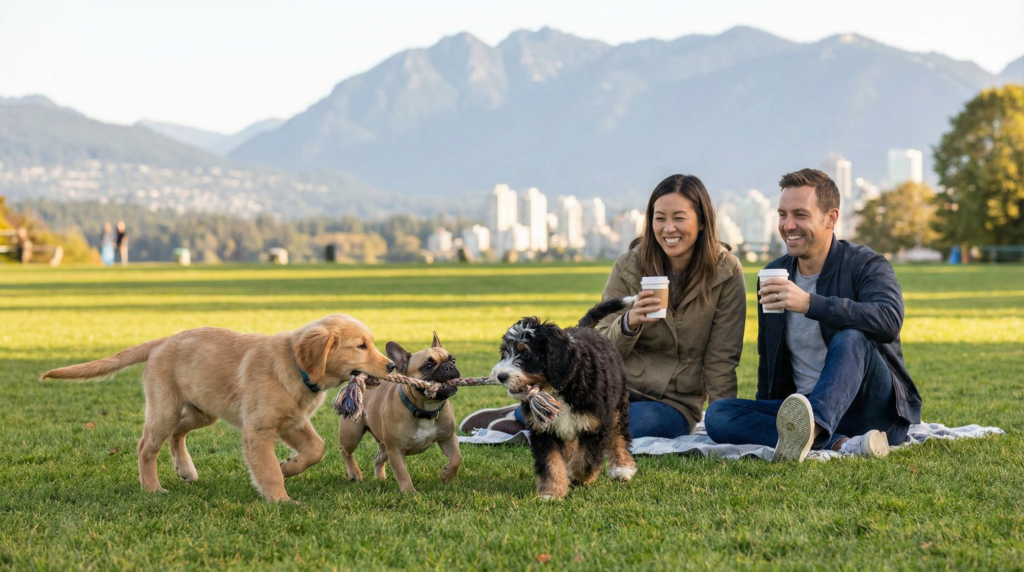
Bringing a new puppy home is an experience filled with joy, excitement, and the pitter-patter of tiny paws. As a new puppy parent in a bustling city like Vancouver, one of the most crucial gifts you can give your young dog is the gift of socialization. Proper socialization during the critical early weeks of a puppy’s life is the single most important factor in shaping a confident, well-adjusted, and resilient adult dog who can happily navigate city life, from a stroll down Commercial Drive to a visit to a dog-friendly patio.
TL;DR: Puppy Socialization in Vancouver
- Socialize your puppy early (up to 16 weeks) to build confidence.
- Expose them gently to Vancouver’s sights, sounds, people, and dogs.
- Use positive reinforcement to create happy associations.
- Join local puppy classes for guided socialization.
- Well-socialized pups become happier, calmer city companions.
This guide will walk you through the what, why, and how of puppy socialization in Vancouver. We will explore the critical developmental window, provide a roadmap for positive exposure, and share a list of top-notch puppy socialization classes available right here in the city. Understanding and committing to this process will prevent fear-based behaviors from developing and ensure your puppy grows into a happy, social member of your family and the community.
The Critical Socialization Window: A Once-in-a-Lifetime Opportunity
From the moment they are born until about 14 to 16 weeks of age, puppies go through a critical developmental period. During this time, their brains are like sponges, soaking up information about the world and forming lasting associations. Experiences during this window have a profound and permanent impact on their future temperament and behavior. A puppy who has positive, controlled experiences with a wide variety of sights, sounds, people, and other dogs is far more likely to be a stable and confident adult.
Conversely, a lack of exposure during this period can lead to a dog who is fearful of new things, which can manifest as anxiety, reactivity, or even aggression later in life. The goal of socialization is not to have your puppy play with every dog they see, but to teach them that new and novel things are not scary. It is about building a foundation of resilience and a positive worldview.
“The most common cause of aggression in the adult dog is lack of proper socialization as a puppy.” – Dr. Ian Dunbar, Veterinarian and Animal Behaviorist
A Socialization Roadmap for the Vancouver Puppy
Socialization is a systematic and gentle process. The key is to create positive associations with new experiences, never forcing your puppy into a situation where they feel overwhelmed. Use high-value treats, praise, and a calm demeanor to help your puppy see the world as a safe and wonderful place. Your socialization checklist should include a wide range of urban and natural stimuli found in Vancouver.
- People: Introduce your puppy to people of all shapes, sizes, and appearances. This includes people wearing hats, sunglasses, and backpacks; people with beards; children (supervised); and people of different ethnicities.
- Sounds: Expose your puppy to common city sounds, such as traffic, sirens, construction noise, and the SkyTrain. Start at a distance where the sound is not overwhelming and reward your puppy for calm behavior.
- Surfaces: Let your puppy walk on a variety of surfaces, including grass, pavement, gravel, sand, and the wooden planks of a pier.
- Environments: Take your puppy on short, positive trips to different environments. This could include a quiet, dog-friendly hardware store, the outside of a busy coffee shop, or a calm park bench where you can watch the world go by.
Puppy Socialization Classes in Vancouver
While you can and should do a lot of socialization on your own, structured puppy socialization classes are an invaluable resource. These classes provide a safe, clean, and controlled environment for puppies to interact with other puppies of a similar age. A good class is supervised by a certified professional trainer who can facilitate appropriate play and ensure all interactions are positive.
Here are some of the top-rated puppy socialization classes in Vancouver:
| Training School | Program Highlights | Website |
|---|---|---|
| **When Hounds Fly** | Puppy Start Right classes that can be started at any time. Focus on socialization, confidence building, and foundational manners. | [whenhoundsfly.com](https://whenhoundsfly.com/vancouver/puppy-socialization-classes/) |
| **The Dog School** | Flexible puppy training for dogs 8-16 weeks old. Includes socialization, confidence building, and a free Saturday Puppy Play session. | [thedogschool.ca](https://www.thedogschool.ca/) |
| **Canine Connection Training** | Puppy Social classes in a controlled, safe setting where puppies can learn proper play skills and burn off energy. | [canineconnectiontraining.ca](https://www.canineconnectiontraining.ca/vancouver-puppy-socialization) |
| **Raintown Dog Training** | 30-minute puppy socialization drop-in sessions focused on off-leash play and socialization activities. | [raintowndogtraining.com](https://www.raintowndogtraining.com/puppy-socialization-dropins) |
Balancing Socialization and Safety
One of the biggest concerns for new puppy owners is how to socialize their puppy before they are fully vaccinated. This is a valid concern, and it is important to talk to your veterinarian about the risks in your specific area. However, the veterinary community is largely in agreement that the risk of behavioral problems from a lack of socialization is far greater than the risk of disease. The American Veterinary Society of Animal Behavior (AVSAB) states that puppies should be socialized before they are fully vaccinated.
To socialize your puppy safely, you can:
- Carry your puppy in areas where the vaccination status of other dogs is unknown.
- Use a puppy stroller or a carrier bag.
- Arrange playdates with healthy, friendly, and fully vaccinated adult dogs that you know.
- Enroll in a reputable puppy class that requires proof of vaccination and has strict cleaning protocols.
By investing time and effort into socialization during these crucial early weeks, you are making a lifelong investment in your dog’s well-being. You are laying the groundwork for a dog who is a pleasure to be around and a true companion who can share in all the adventures that life in Vancouver has to offer.
References
[1] American Veterinary Society of Animal Behavior. (2008). AVSAB Position Statement on Puppy Socialization. Retrieved from https://avsab.org/wp-content/uploads/2018/03/Puppy_Socialization_Position_Statement_Download_-_10-3-14.pdf
[2] When Hounds Fly. (n.d.). Puppy Socialization Classes in Vancouver. Retrieved from https://whenhoundsfly.com/vancouver/puppy-socialization-classes/
[3] The Dog School. (n.d.). Home. Retrieved from https://www.thedogschool.ca/
Deep Dive AI Prompts
Use these prompts with ChatGPT or any AI assistant to explore this topic further:
- “Explain the neuroscience of the canine socialization window. What is happening in the puppy’s brain between 3 and 16 weeks, and why does missing this window have lasting consequences?”
- “Design a comprehensive 8-week socialization checklist for a new puppy in Vancouver. Include specific experiences, environments, sounds, people types, and other animals to expose the puppy to safely.”
- “What is the current veterinary guidance on balancing socialization with vaccination risk in puppies? When is it safe to take a puppy to dog parks, puppy classes, and public spaces in Vancouver?”
- “How does under-socialization contribute to fear, aggression, and reactivity in adult dogs? What are the most common socialization mistakes Vancouver dog owners make, and how can they be avoided?”
Frequently Asked Questions
When does the socialization window close? The primary socialization window is generally considered to be between 3 and 12–16 weeks of age, with the most sensitive period being 3–8 weeks. After 16 weeks, new experiences become progressively harder to process without fear. This does not mean socialization stops mattering after 16 weeks — continued positive exposure throughout the first year is important — but the foundational window is brief, which is why starting early is so critical.
Is it safe to socialize my puppy before they are fully vaccinated? Yes, with sensible precautions. The American Veterinary Society of Animal Behavior states that the socialization benefits of early exposure outweigh the disease risk for most puppies. Safe options before full vaccination include: puppy classes held on clean indoor surfaces, visits to the homes of vaccinated dogs, carrying your puppy in areas with unknown dog traffic (rather than letting them walk on the ground), and avoiding dog parks and high-traffic areas until two weeks after the final vaccine.
What counts as good socialization? Good socialization means pairing new experiences with positive emotions — not just exposure. A puppy that is dragged toward a scary object and overwhelmed is not being socialized; they are being traumatised. The goal is to let your puppy approach new things at their own pace, reward calm and curious behaviour generously, and end every session on a positive note. Quality matters more than quantity: five calm, positive encounters are worth more than fifty stressful ones.
My puppy seems scared of everything. Is it too late to help them? It is never too late to make progress, though it does become more work after the socialization window closes. A fearful puppy or young adult dog can improve significantly with a structured desensitisation and counter-conditioning programme — gradually exposing them to scary things at a distance and intensity that does not trigger fear, while pairing those exposures with high-value rewards. Working with a certified professional dog trainer or veterinary behaviourist will give you the best results.
Related Reading
- Your Puppy’s First Vet Visit in Vancouver: What to Expect and How to Prepare
- How to Choose a Veterinarian in Vancouver: A Guide for New Dog Owners
- Preparing Your Home for a New Puppy: The Ultimate Vancouver Checklist
Sources & Further Reading
Next Steps: Puppy Socialization Checklist
- Schedule your puppy’s first vet visit and discuss socialization milestones.
- Enroll in a local puppy socialization class in Vancouver, such as those offered at community centres or dog training schools.
- Plan daily short outings exposing your puppy to different people, sounds, and environments around Marpole and greater Vancouver.
- Use high-value treats and calm praise to reward your puppy’s positive reactions to new experiences.
- Introduce your puppy to friendly, vaccinated dogs in controlled settings to build social skills.
- Keep a journal of your puppy’s socialization progress and note any concerns to discuss with a trainer or vet.
Pingback: Preparing Your Home for a New Puppy: The Ultimate Vancouver Checklist